Activity 2.3.5 — XOR & XNOR Gates
Learning Objectives
By the end of this lesson, students will be able to:
- Describe the difference between XOR and XNOR gates and identify their unique truth tables.
- Apply XOR properties to simplify Boolean expressions.
- Explain how XOR gates are used in binary addition and comparison applications.
- Build and verify XOR and XNOR circuits using logic gates.
Vocabulary
Vocabulary (click to expand)
| Term | Definition |
|---|---|
| XOR (Exclusive OR) | A logic gate that produces a HIGH output only when the inputs are different (one HIGH, one LOW). |
| XNOR (Exclusive NOR) | A logic gate that produces a HIGH output only when the inputs are the same (both HIGH or both LOW). |
| Parity | A property of binary numbers describing whether the number of 1s is odd or even. |
| Odd Parity | The condition where the number of 1s in a binary word is odd. |
| Even Parity | The condition where the number of 1s in a binary word is even. |
| Inequality Detector | A circuit that produces a HIGH output when inputs are different. |
Part 1: XOR Gate Fundamentals
The XOR (Exclusive OR) gate is a fundamental building block in digital electronics. Unlike the standard OR gate, the XOR gate produces a HIGH output only when the inputs are different.
XOR Truth Table
| A | B | Y = A xor B |
|---|---|---|
| 0 | 0 | 0 |
| 0 | 1 | 1 |
| 1 | 0 | 1 |
| 1 | 1 | 0 |
Key Observation
XOR is HIGH when:
- A = 0 and B = 1 (inputs are DIFFERENT)
- A = 1 and B = 0 (inputs are DIFFERENT)
XOR is LOW when:
- A = 0 and B = 0 (both are the same - both LOW)
- A = 1 and B = 1 (both are the same - both HIGH)
Key insight: XOR is a “difference detector” - it outputs 1 when the inputs differ, and 0 when they’re the same.
XOR Symbol
The XOR gate uses the symbol A ⊕ B (where ⊕ is the XOR operator):
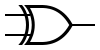 XOR Gate
Output HIGH when inputs are different
Part 2: XNOR Gate Fundamentals
The XNOR (Exclusive NOR) gate is the complement of XOR. It produces a HIGH output when the inputs are the same.
XNOR Truth Table
| A | B | Y = A xnor B |
|---|---|---|
| 0 | 0 | 1 |
| 0 | 1 | 0 |
| 1 | 0 | 0 |
| 1 | 1 | 1 |
Key Observation
XNOR is HIGH when:
- A = 0 and B = 0 (both are LOW - SAME)
- A = 1 and B = 1 (both are HIGH - SAME)
XNOR is LOW when:
- A = 0 and B = 1 (inputs are DIFFERENT)
- A = 1 and B = 0 (inputs are DIFFERENT)
Key insight: XNOR is an “equality detector” or “coincidence detector” - it outputs 1 when inputs match.
XNOR Symbol
XNOR is often written as A ⊙ B or (A ⊕ B)‘:
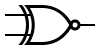 XNOR Gate
Output HIGH when inputs are the same
Part 3: XOR Properties and Algebra
The XOR operation has several useful properties that can simplify circuit design:
XOR Properties
| Property | Expression | Description |
|---|---|---|
| Identity | A ⊕ 0 = A | XOR with 0 returns A |
| Inverse | A ⊕ 1 = \overline{A} | XOR with 1 inverts A |
| Idempotent | A ⊕ A = 0 | XOR with itself = 0 |
| Inverse Property | A ⊕ \overline{A} = 1 | XOR with complement = 1 |
| Commutative | A ⊕ B = B ⊕ A | Order doesn’t matter |
| Associative | (A ⊕ B) ⊕ C = A ⊕ (B ⊕ C) | Grouping doesn’t matter |
XOR Implementation with Basic Gates
XOR can be implemented using basic gates:
A ⊕ B = A·\overline{B} + \overline{A}·BThis translates to:
- One AND gate with A and \overline{B} (A AND NOT B)
- One AND gate with \overline{A} and B (NOT A AND B)
- One OR gate combining the two AND outputs
      A----|\
           & |\
      \overline{B}---|  )---+--- Y
           |/      |
      B-----------+      (wait, this isn't right)

Actually:
       A----|\
            & |\
       \overline{B}---|  )---+---\
       \overline{A}---|/      )---+--- Y
       B ----------|/
Key insight: The XOR expression A ⊕ B = A·\overline{B} + \overline{A}·B shows it’s the sum of the cases where one input is 1 and the other is 0.
Part 4: Applications of XOR
Binary Addition (Half Adder)
One of the most important applications of XOR is in binary addition. The SUM bit of a half adder is exactly XOR of the two inputs:
| A | B | Sum (A ⊕ B) | Carry (A·B) |
|---|---|---|---|
| 0 | 0 | 0 | 0 |
| 0 | 1 | 1 | 0 |
| 1 | 0 | 1 | 0 |
| 1 | 1 | 0 | 1 |
The Sum output = A ⊕ B The Carry output = A · B
Comparison / Equality Detection
XOR can be used to compare two bits:
- If A ⊕ B = 0, then A = B
- If A ⊕ B = 1, then A ≠ B
Extending this to multiple bits requires checking if all XOR outputs are 0.
graph LR
    A["4-bit<br/>Value A"] --> XOR1["XOR"]
    A --> XOR2["XOR"]
    A --> XOR3["XOR"]
    A --> XOR4["XOR"]
    B["4-bit<br/>Value B"] --> XOR1
    B --> XOR2
    B --> XOR3
    B --> XOR4
    XOR1 --> NOR["NOR<br/>(4-input)"]
    XOR2 --> NOR
    XOR3 --> NOR
    XOR4 --> NOR
    NOR --> EQ["Equal?<br/>1 = Same<br/>0 = Different"]

    style XOR1 fill:#bbf,stroke:#333
    style XOR2 fill:#bbf,stroke:#333
    style XOR3 fill:#bbf,stroke:#333
    style XOR4 fill:#bbf,stroke:#333
    style NOR fill:#fdb,stroke:#333
    style EQ fill:#bfb,stroke:#333,stroke-width:2px
Parity Checking
Parity is used for error detection:
- Even parity: Number of 1s in the word is even (including parity bit)
- Odd parity: Number of 1s in the word is odd (including parity bit)
An XOR chain can count the number of 1s:
- Even number of 1s → XOR output = 0
- Odd number of 1s → XOR output = 1
graph LR
    D0["Bit 0"] --> XOR1["XOR"]
    D1["Bit 1"] --> XOR1
    XOR1 --> XOR2["XOR"]
    D2["Bit 2"] --> XOR2
    XOR2 --> XOR3["XOR"]
    D3["Bit 3"] --> XOR3
    XOR3 --> P["Parity Bit<br/>0 = Even<br/>1 = Odd"]

    style XOR1 fill:#bbf,stroke:#333
    style XOR2 fill:#bbf,stroke:#333
    style XOR3 fill:#bbf,stroke:#333
    style P fill:#bfb,stroke:#333,stroke-width:2px
7486 Quad XOR IC
The 7486 is a quad 2-input XOR IC containing four independent XOR gates:
- Package: 14-pin DIP
- Four 2-input XOR gates
- Useful for building comparators, adders, and parity generators
Part 5: XNOR Applications
XNOR is essentially an inverted XOR, making it useful for:
Equality Comparison
XNOR outputs 1 when inputs match, making it perfect for checking if two bits are equal:
- A ⊙ B = 1 means A = B
Inverting Selector
XNOR acts as an inverting data selector:
- When select = 0: output = input
- When select = 1: output = input’ (inverted)
Parity (Even)
XNOR can be used for even parity checking:
- Even number of 1s → XNOR output = 1
Key insight: XOR and XNOR are inverses of each other. XNOR = (XOR)’ and XOR = (XNOR)’.
Practice Problem — XOR Truth Table Verification
Problem: Complete the truth table and verify the XOR pattern:
| A | B | A ⊕ B |
|---|---|---|
| 0 | 0 | ? |
| 0 | 1 | ? |
| 1 | 0 | ? |
| 1 | 1 | ? |
Show Solution
| A | B | A ⊕ B |
|---|---|---|
| 0 | 0 | 0 |
| 0 | 1 | 1 |
| 1 | 0 | 1 |
| 1 | 1 | 0 |
XOR = 1 only when inputs are different.
Practice Problem — Simplify XOR Expressions
Problem 1: Simplify A ⊕ 0
Problem 2: Simplify A ⊕ A
Problem 3: Simplify A ⊕ \overline{A}
Show Solution
Problem 1: A ⊕ 0 = A (Identity property: XOR with 0 returns the other input)
Problem 2: A ⊕ A = 0 (Idempotent property: XOR with itself equals 0)
Problem 3: A ⊕ \overline{A} = 1 (Inverse property: XOR with complement equals 1)
Practice Problem — Build XOR with Basic Gates
Problem: Draw the gate-level circuit to implement A ⊕ B using AND, OR, and NOT gates.
Show Solution
The Boolean expression is: A ⊕ B = A·\overline{B} + \overline{A}·B
      A--------|\
               & |\
      B----NOT--|  )---+--- OR ---- Y
               |/      |
      A----NOT--|\
               & |/
      B---------|/
Steps:
- Create \overline{B} using NOT gate on B
- Create \overline{A} using NOT gate on A
- AND A with \overline{B} → first term (A·\overline{B})
- AND \overline{A} with B → second term (\overline{A}·B)
- OR the two terms → final output
Practice Problem — XOR in Binary Addition
Problem: For a half adder with inputs A=1 and B=1: a) What is the SUM output? b) What is the CARRY output?
Show Solution
a) SUM = A ⊕ B = 1 ⊕ 1 = 0 b) CARRY = A · B = 1 · 1 = 1
Result: 1 + 1 = 10 (binary), meaning SUM = 0 and CARRY = 1
Practice Problem — XNOR Application
Problem: How would you use an XNOR gate to detect if two bits A and B are equal?
Show Solution
Simply connect A and B to the XNOR gate inputs. The output will be 1 when A = B (both 0 or both 1), indicating equality.
Truth table:
- A=0, B=0 → XNOR = 1 (equal)
- A=0, B=1 → XNOR = 0 (not equal)
- A=1, B=0 → XNOR = 0 (not equal)
- A=1, B=1 → XNOR = 1 (equal)
Summary
- XOR produces HIGH only when inputs are different; XNOR produces HIGH when inputs are the same.
- XOR (A ⊕ B) = A·\overline{B} + \overline{A}·B; XNOR = (XOR)’ = A·B + \overline{A}·\overline{B}
- Useful XOR properties: A⊕0=A, A⊕1=\overline{A}, A⊕A=0, A⊕\overline{A}=1
- XOR is used in half adders (SUM output) and comparison circuits.
- XNOR is used for equality detection and even parity checking.
- The 7486 is a quad 2-input XOR IC.
Key Reminders
- XOR = “difference detector” (1 when different)
- XNOR = “equality detector” (1 when same)
- Remember the XOR Boolean expression: A ⊕ B = A·\overline{B} + \overline{A}·B
- XOR gates are essential for building arithmetic circuits.
- Parity checking uses XOR to detect errors in data transmission.
Custom activity — adapted from PLTW Digital Electronics